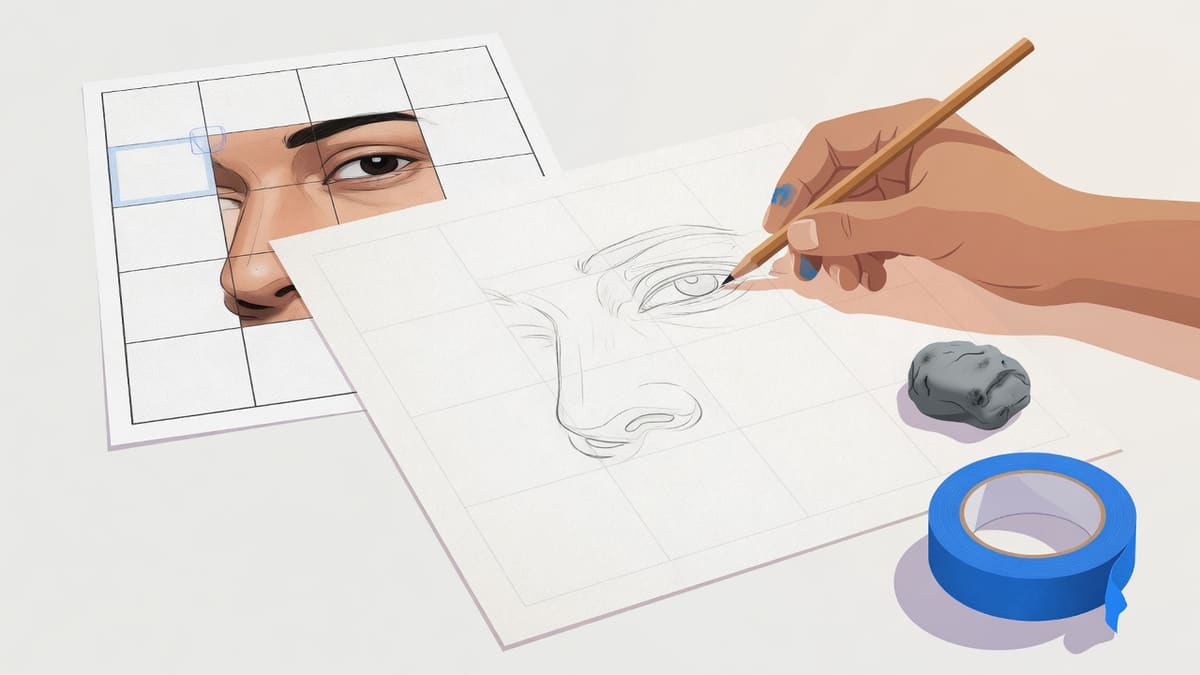
Learn the grid method here, then overlay matching squares on a photo in this browser. Rule the same count on paper, copy one cell at a time, and download PNG or JPG. The file stays in this tab.
Drag & drop your reference image here
Supports JPG, PNG, GIF, WEBP
Upload image
One PNG at 4× this photo’s pixels — a larger print file. Not four copies, and not always 4K.
Blank canvas · 800×600 · 8×8 grid
PNG for print. JPG is smaller. High-res PNG is 4× the pixels — one larger file, not four copies.
Features
What this grid method page does
The tutorial is below the card. The card overlays matching squares on one photo so you can copy them onto paper. Download PNG or JPG in this tab. There is no signup wall.
Matching squares, not a guessed sketch
The overlay on the photo and the grid on paper must share a row count and a column count. This card starts at 8×8. Drag Rows and Columns from 2 to 50. They stay independent unless you turn on Square cells under More options. The identity line names the file, the pixel size, and the grid so you know what you are about to print.
Enlarge by making paper squares larger
How to use the grid method to enlarge an image: keep the same number of cells and grow each cell on the sheet. A postcard overlay at 8×8 becomes a poster at 8×8 if every paper square is bigger. Crop on this card first so the photo and the paper share a shape. We do not calculate wall measurements or gallons of paint.
Labels, crop, and light lines for paper
Show cell labels is on by default so you can say look at C4. Turn labels off if they clutter a face. Crop and rotate sit on the card: Free, Original, 1:1, 4:5, 3:4, 2:3, and 16:9, plus straighten and 90°. On paper, a 2H pencil and a ruler keep the grid light enough to erase after the drawing holds.
The overlay is drawn on this device
The photo never leaves the tab. FileReader plus canvas, no form post, no login. Download PNG for a print-ready reference, JPG for a smaller file, or Download 4× PNG when you need a larger print. Other sites lock 4× and composition guides; they stay free here.
What it is
What is Grid Method Drawing?
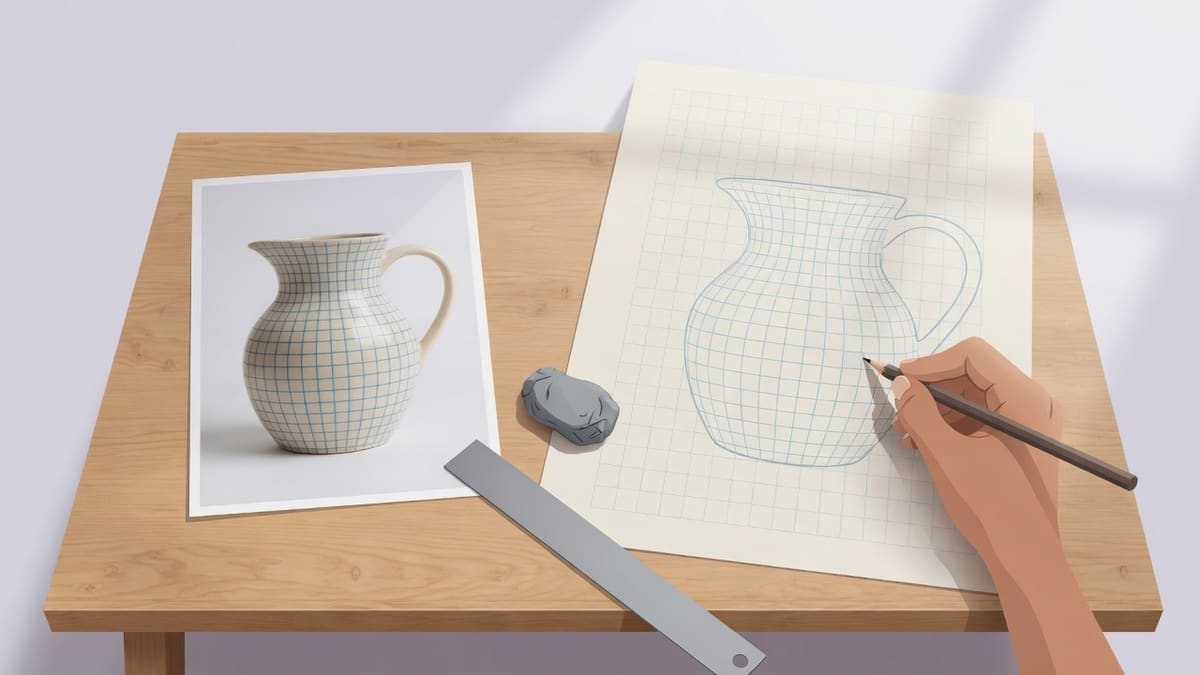
The grid method is a way to copy a reference without guessing where the eyes sit. You overlay even squares on the photo, rule the same number of squares on paper, and draw only what belongs in one cell before you move on. Teachers also call that the square method when the cells stay close to squares. The count must match: if the overlay is eight columns by ten rows, the paper is eight by ten. To enlarge, keep that count and make each paper square larger. To shrink, make each paper square smaller. Crop the photo first so the sheet and the reference share a shape; mismatched aspect ratios are the usual reason a face comes out stretched.
This page is the tutorial for that job, plus the overlay card at the top. Drop a JPG, PNG, GIF, or WEBP, set rows and columns, and download. The photo is opened with FileReader and painted on a canvas in this tab. We do not upload it, we do not ask for an account, and a weak connection does not block the save. Diagonals, rule of thirds, golden ratio, crop, rotate, and 4× PNG stay free on the same card.
Squared transfer is older than this website. Alberti described a veil of threads. Dürer drew frames that hold a grid between the eye and the subject. Egyptian wall painters used proportional canons. Chuck Close used grids in public as structure, not as a hidden trick. None of that paints the picture for you. The overlay only answers where things go. Values, edges, and color are still yours. This URL is grid method art and grid method drawing — not grid-method multiplication, not grid search for machine learning, not MethodGrid the product, and not a mural calculator that prints chalk lines in feet.
Input
One JPG, PNG, GIF, or WEBP, or a blank 800×600 canvas
Upload
None. The photo is read in this tab
Account
Not required
Export
PNG, JPG, or a free 4× high-resolution PNG of the gridded image
How to use
How to use the grid method
Step 1
Overlay the reference on this card
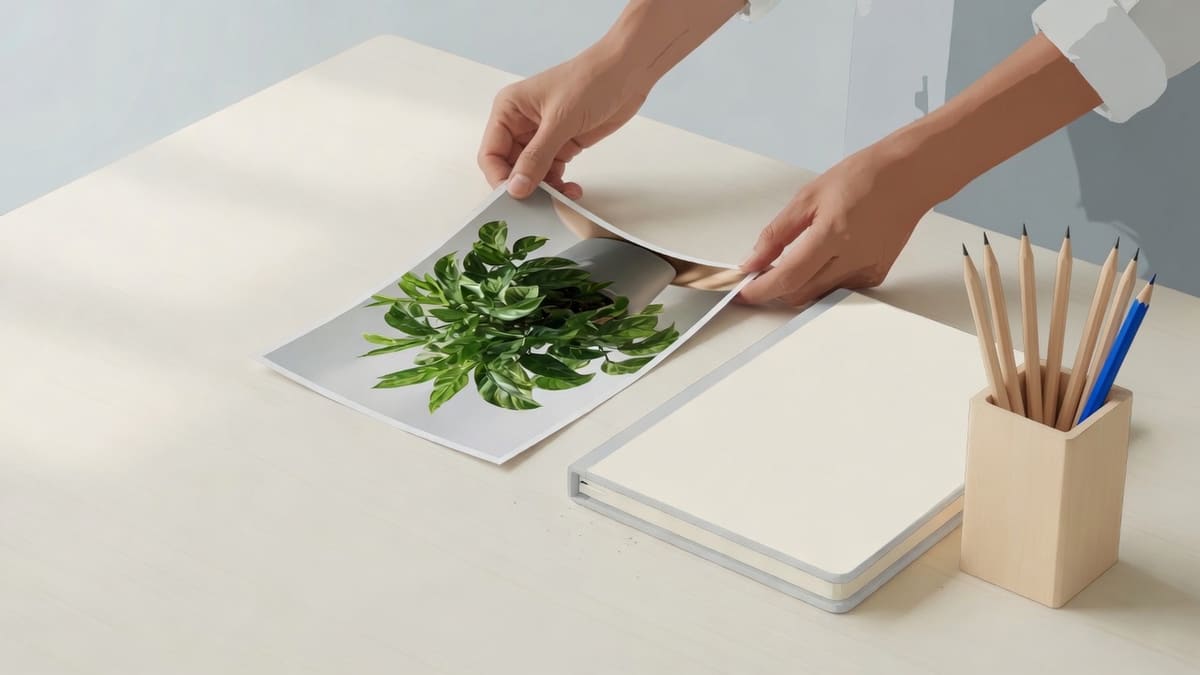
Drop a JPG, PNG, GIF, or WEBP, or click to pick one file. Crop away wall or table you will not draw. Set rows and columns so each square holds a decision you can actually copy. Tune color and opacity until every edge is obvious. PDF and video are not accepted.
Step 2
Rule the same count on paper
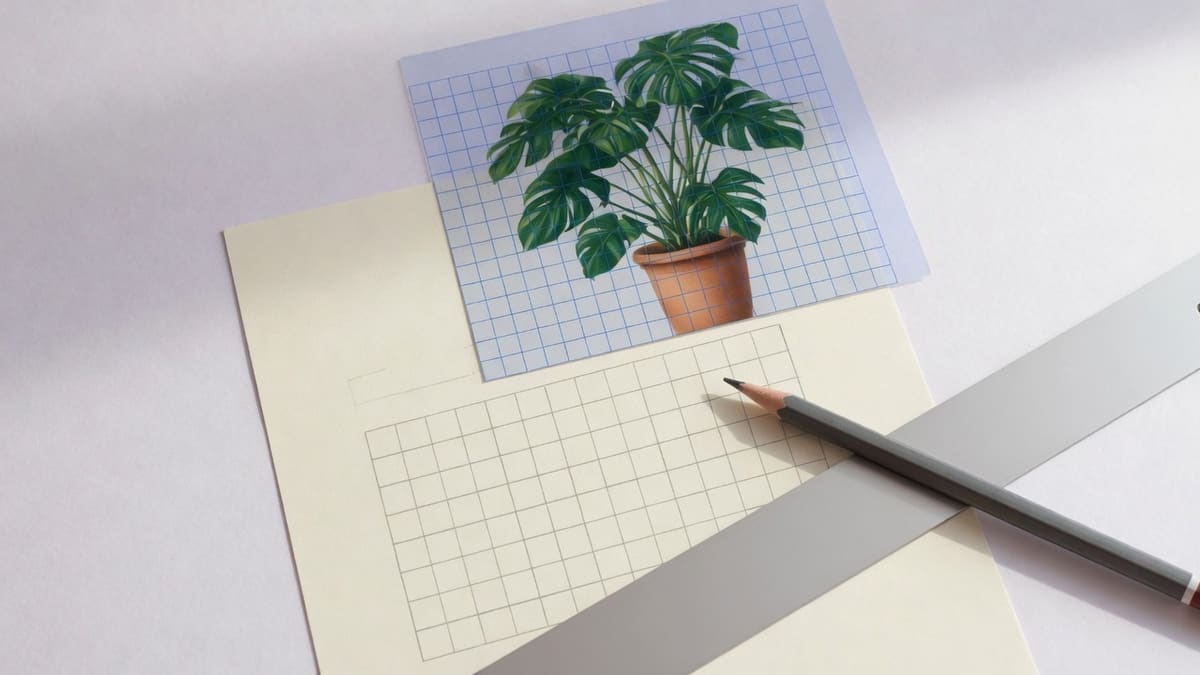
Download PNG or keep the preview on a second screen. On your sheet, measure the outer rectangle so it matches the photo’s shape, then divide each edge into the same number of segments. Light pencil, ruler, optional A1 labels. If you are enlarging, those paper squares are simply bigger. Do not change the count.
Step 3
Copy one square, then erase the paper grid
Work cell by cell. Copy where lines cross the square’s edges first; those crossings are anchors. Ignore eyelashes until the head sits. When the drawing holds, erase the light grid with a kneaded eraser. The overlay on the photo can stay — you already have the download.
Limits
What this page will not invent
This tutorial is for drawing transfer: overlay, matching squares, enlarge by bigger paper cells. It is not grid-method multiplication, not grid search in machine learning, and not MethodGrid software. It does not print an A4 graph-paper PDF, a mural plan in feet, a Procreate brush, or a crochet chart. If you only need lines on a photo, use the grid overlay page. The same card framed as a grid drawing tool lives at grid drawing. Searches for add grid to photo land on add grid to photo. Diagonals, thirds, golden ratio, crop, and 4× PNG stay free on the card.
Why choose
What this grid method page actually delivers
The tutorial plus the overlay card, without a mural calculator or a maths worksheet.
The tutorial lives on this URL, not the homepage
The homepage keeps one short line about cheating. This page is the independent guide: what the grid method is, how matching squares work, how to enlarge, how to choose 4×4 versus 10×10, and how to rule paper. People who type how to use the grid method should land here, not on a generic maker blurb.
The photo never becomes a server copy
Several overlay sites still talk about upload even when the work is local. This page is explicit: FileReader plus canvas, no account, nothing stored after you leave. If you are copying a client portrait, that is the reason to stay on this card instead of a tool that keeps files.
Guides and 4× stay free
Diagonal triangulation, rule of thirds, golden ratio, crop, rotate, and 4× PNG sit on the same card with no trial. Other grid sites sell those extras. You still have to draw. We just do not hide the measuring aids behind a paywall.
Honest declines sit next to the steps
We do not factorise polynomials, we do not print A4 graph-paper PDFs, we do not project a mural in feet, and we do not install a Procreate brush. If a search for the grid method meant arithmetic or a tablet plugin, this URL will say so instead of faking a result.
Limits and tips
Tips for copying with the grid method
Keep the count matching, keep paper lines light, and enlarge by bigger squares — not more squares.
Crop so the paper and the photo share a shape: If the reference is 4:5 and the sheet is 2:3, matching counts still stretch the face. Crop on this card first, then set rows and columns. Extra background wastes squares and makes the paper grid harder to match.
Pick 4×4, 8×8, or 10×10 on purpose: A 4×4 overlay is enough for a simple object. 8×8 is a practical default for a pet or a head. 10×10 and up help when a portrait or hands need smaller decisions. More squares slow you down if the subject is simple.
Keep the paper grid light: Use a hard pencil and a ruler. Heavy lines dent the sheet and will not erase cleanly. Copy edge crossings first, then interiors. Labels help in a classroom; turn them off on a detailed face if they clutter the download.
Do not expect a different product: This page will not teach Loomis construction, Bargue plates, crime-scene search grids, or story-grid plotting. It will not export a knitting chart. The job is matching squares on one photo and one sheet.
Use cases
Who the grid method is for
Still life, portraits, and scale-up jobs that keep the same square count on photo and paper.
Beginner still life, coarse squares
Someone new to grid method drawing wants to copy a bowl and a bottle without the ellipse drifting.
Input: One well-lit JPG or WEBP of a simple still life already on the phone or laptop.
Setting: Crop to the objects, 6 rows by 6 columns, labels on, dark line at about 35 percent opacity.
Output: A PNG of the same still life with a 6×6 overlay, plus a matching 6×6 pencil grid on cheap paper.
Caveat: This does not correct lens distortion. Use Crop & rotate if you only want the objects, not the table edge.
Portrait onto sketch paper
A student needs the grid method for a head-and-shoulders photo so the eye line stays put.
Input: One portrait photo as JPG or PNG.
Setting: Crop to the head, 10×10 overlay, labels on so a teacher can say look at cell D5, medium line width.
Output: A 10×10 PNG you can print or keep on a second screen while ruling 10×10 on paper.
Caveat: We do not generate a worksheet pack. You still photocopy or share the PNG yourself.
Enlarge a small sketch to a larger sheet
You already have a postcard-size sketch and want the same proportions on a bigger page.
Input: A photo or scan of the small sketch as JPG or PNG.
Setting: Coarse grid such as 8×8 so the larger paper squares stay practical to rule by hand.
Output: An 8×8 overlay of the sketch. On the larger sheet you rule 8×8 with bigger cells and copy square by square.
Caveat: This page does not calculate inches per square or wall chalk-line positions. Count squares by hand.
FAQ
Grid method questions
What is the grid method?
The grid method is a drawing transfer: overlay even squares on a reference, rule the same count of squares on paper, then copy one cell at a time. Landmarks stay inside matching squares so proportions do not drift. This page draws the overlay in the browser; you still make every pencil mark.
How do I use the grid method for drawing?
Drop a JPG or PNG on the card, set rows and columns, then download the overlay. Print that file or keep it on a second screen. Rule the same number of rows and columns on paper with a light pencil. Copy only what sits in one square, then move to the next. Erase the paper lines when the drawing holds.
Is the grid method cheating?
No. A matching grid is a measuring aid, like a ruler or a plumb line. Artists used thread veils and squared cartoons long before this website existed. The overlay does not paint for you. You still choose edges, values, and color. This page only draws the squares on the photo.
Is grid method tracing?
No. Tracing copies a contour by laying paper on the photo. The grid method copies relationships: where a line hits a square edge, how far an eye sits from a cell corner. You look at the reference and redraw it. That is observation with checkpoints, not a trace that paints the picture for you.
What grid size should I use for my drawing?
Start with 4×4 or 6×6 on a simple still life. Use 8×8 for most portraits and pets. Move to 10×10 or 12×12 when a face or hands need smaller decisions. More squares slow you down if the subject is simple. Rows and columns on this card go from 2 to 50 and stay independent unless you turn on Square cells.
How do I scale a grid drawing to a larger canvas?
Keep the same row and column count on the photo and on the paper. Make each paper square larger. An 8×8 overlay on a postcard becomes an 8×8 drawing on a poster if every paper cell is bigger. Crop the photo first so the aspect ratio matches the sheet. This page does not print a mural plan in feet or gallons of paint.
Is the square method the same as the grid method?
In drawing class those names usually mean the same job: matching squares on a reference and on paper. Some teachers say square method when every cell is close to a square. On this card, Square cells is optional under More options and off by default. Leave it off to set any row count and any column count on their own.
How to use the grid method in maths?
This URL is not a multiplication, division, or factorisation calculator. Those classroom pages partition numbers into boxes, not photos into drawing squares. If you need to copy a picture square by square, stay here. For arithmetic grids, use a maths worksheet instead of this overlay.
Do I need an app to use the grid method?
No. Open this page in a normal desktop or phone browser. There is no Procreate brush, ibis Paint plugin, Chrome extension, or app-store listing. The overlay is FileReader plus canvas on this URL. If a search result is a store page, that is a different product.
How do I transfer the grid to my paper?
Download the overlay, then rule the same count of rows and columns on your sheet with a hard pencil and a ruler. Keep those lines light so they erase later. Optional A1 labels help you call a square out loud. Copy edge crossings first so shapes land in the right cell before you add tone.
Do I need to erase the grid lines after transferring?
Yes, once the drawing is strong enough to stand without the squares. Use a kneaded eraser and a light 2H grid so the lines come off without taking the sketch. If you paint, you can leave the grid under the first wash and cover it. This page does not erase anything on paper.
Can I use the grid method with any aspect ratio?
The overlay follows the photo you drop. If the paper is a different shape, crop the photo on this card first so every square is useful. Independent rows and columns let you run 8 by 12 on a tall portrait. We do not stretch the photo to fake a match, and we do not invent a paper size you did not choose.
How to do grid method on procreate?
This page is a browser overlay, not a Procreate lesson. Drop the photo here, download PNG, then place that file in Procreate as a reference layer if you want. We do not install a Procreate grid brush, an ibis Paint filter, or a Photoshop action. The same PNG also prints for paper work.
Why is the grid method used in art?
It isolates one problem: where things sit. Color mixing, edges, and values stay yours. Teachers use it because beginners can finish a portrait without the eyes drifting. Historians point to Alberti’s veil and Dürer’s squared frames. Painters such as Chuck Close used grids as structure in public, not as a hidden shortcut.
What is grid method drawing for beginners?
Pick a high-contrast photo, crop extra background, set a coarse overlay such as 6×6, and copy big shapes first. Ignore eyelashes until the head sits correctly. Download PNG, rule matching squares on cheap paper, and treat each cell as a tiny still life. This card is free and does not require an account.
When was the grid method invented?
Squared transfer is old. Egyptian wall painters used proportional canons. Alberti described a thread veil in the 1400s. Dürer drew devices that hold a grid between the eye and the subject. This page does not claim to have invented the method; it only overlays the squares on a photo you already have, in this browser.
Is the grid method overlay free?
Yes. Crop, rotate, diagonals, rule of thirds, golden ratio, and 4× PNG sit on the same card with no trial. You do not create an account. The photo is not posted to a server. Other grid sites lock those extras; they stay free here.
Can I download the gridded reference?
Yes. Download PNG for a print-ready reference, JPG for a smaller file, or Download 4× PNG when you need a larger print. Confirm the filename and pixel size in the result heading before you save. PDF worksheets, ZIP packs, and layered PSD files are not offered on this URL.
What is grid method art?
Grid method art is observational drawing that uses matching squares on a reference and on paper. Teachers also say grid method drawing. This page is that job: overlay the photo here, rule the same count on the sheet, copy one cell at a time. It is not a style filter and not an AI image generator.
Is this the grid search method from machine learning?
No. Grid search in ML tries hyperparameter combinations. This URL overlays squares on a photo so you can copy it onto paper. If you landed here from a data-science query, use a machine-learning reference instead of this drawing card.
How do I do grid method drawing on this page?
Drop a JPG or PNG, crop extra background, set rows and columns, then download the overlay. Rule the same count on paper with a light pencil. Copy edge crossings first, then interiors. Erase the paper grid when the drawing holds. That is grid method drawing here, without an account.
Overlay the reference on this page
Drop a photo, set matching squares, then copy them onto paper. This button only scrolls to the card.